

Remember when LinkedIn was just a glorified digital resume? A place you only visited when you were either job hunting or awkwardly avoiding an old boss? Those days are long gone. In 2026, LinkedIn has solidified itself as the undisputed powerhouse for B2B lead generation.
But here is the reality check: most businesses are still treating it like a digital billboard. They post, they hope, and then they wonder why their “engagement” isn’t paying the bills. If you’ve ever felt the frustration of a post getting 10,000 views but exactly zero inquiries, you’re experiencing the Engagement Trap.
High reach is vanity; a structured linkedin lead generation funnel is sanity.
Generating B2B leads today isn’t about going viral. It’s about building a system that guides a professional through a journey—starting from the moment they scroll past your headshot to the moment they sign a contract. In this guide, we’ll break down the five stages of a high-converting LinkedIn funnel that turns “impressions” into ROI.
What Is a LinkedIn Lead Generation Funnel?
Think of a linkedin marketing funnel as a filter. At the top, you have a massive audience of 1.3 billion members. As they move down, you filter for interest, then for need, and finally for intent.
Unlike a traditional sales funnel that might happen entirely on your website, a linkedin conversion funnel often starts on the platform and lives there for a significant portion of the buyer journey.
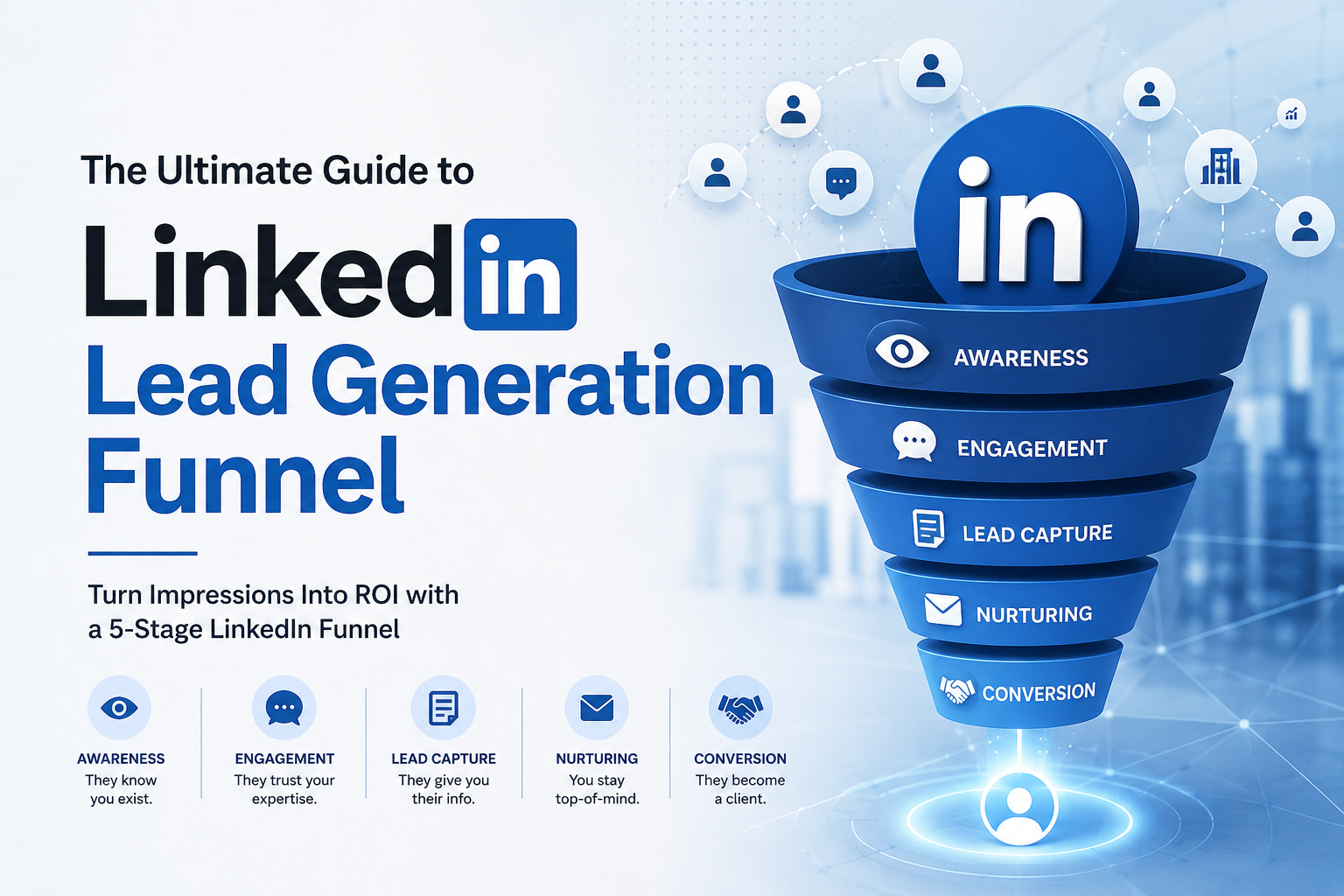
The 5 Core Stages:
1. Awareness: They know you exist.
2. Engagement: They trust your expertise.
3. Lead Capture: They give you their contact info.
4. Nurturing: You stay top-of-mind.
5. Conversion: They become a client.
Every stage requires a different “language.” You wouldn’t ask someone to marry you on a first date, and you shouldn’t ask a CEO for a demo in your first post. A successful marketing funnel respects the pace of the professional relationship.
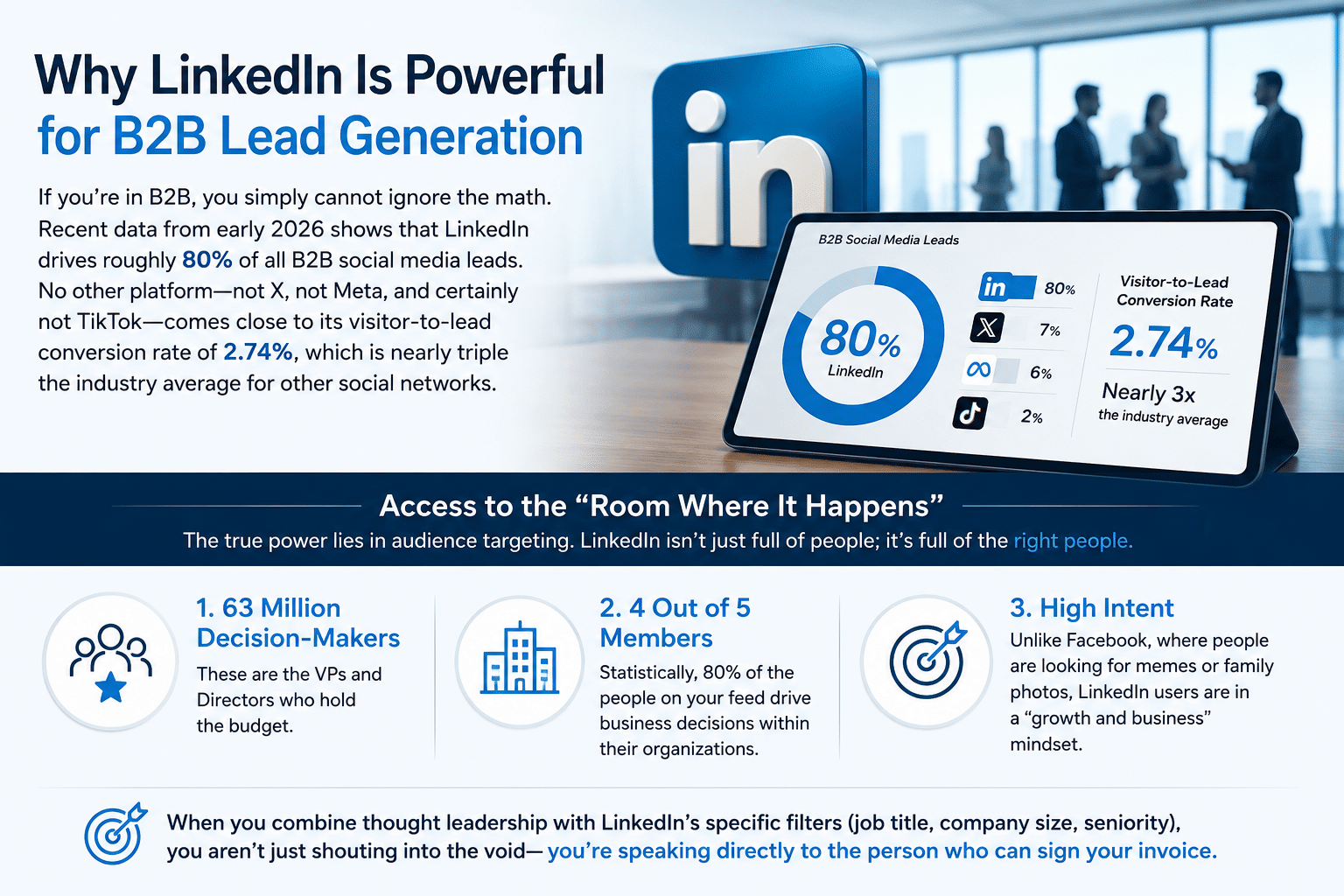
Why LinkedIn Is Powerful for B2B Lead Generation
If you’re in B2B, you simply cannot ignore the math. Recent data from early 2026 shows that LinkedIn drives roughly 80% of all B2B social media leads. No other platform—not X, not Meta, and certainly not TikTok—comes close to its visitor-to-lead conversion rate of 2.74%, which is nearly triple the industry average for other social networks.
Access to the “Room Where It Happens”
The true power lies in audience targeting. LinkedIn isn’t just full of people; it’s full of the right people.
1. 63 Million Decision-Makers: These are the VPs and Directors who hold the budget.
2. 4 Out of 5 Members: Statistically, 80% of the people on your feed drive business decisions within their organizations.
3. High Intent: Unlike Facebook, where people are looking for memes or family photos, LinkedIn users are in a “growth and business” mindset.
When you combine thought leadership with LinkedIn’s specific filters (job title, company size, seniority), you aren’t just shouting into the void—you’re speaking directly to the person who can sign your invoice.
Stage 1: Building Awareness Through LinkedIn Content
The top of the funnel (TOFU) is about one thing: visibility. But not just any visibility—relevant visibility. If you sell industrial CNC software, you don’t need a million teenagers to see your post. You need 500 manufacturing heads to see it.
Content That Stops the Scroll
In 2026, the linkedin content funnel is dominated by formats that provide immediate, ungated value.
1. Educational Carousels: These are the current kings of reach, boasting an average engagement rate of 6.6% to 7%. They keep users on the platform (which the algorithm loves) while demonstrating your deep industry knowledge.
2. Native Video: Short, 30–90 second videos of you or your team solving a common industry pain point. Pro tip: Always use captions—80% of users watch LinkedIn videos with the sound off.
3. Opinion-Based Text Posts: B2B buyers are tired of “safe” corporate speak. Strong thought leadership that takes a stand on an industry trend builds authority faster than any generic “5 Tips” post.
The goal here isn’t to sell. It’s to make your target audience think, “This person actually knows what they’re talking about.”
Stage 2: Increasing Engagement and Building Trust
Once people know you exist, they need to believe you. This is the middle of the funnel (MOFU). In B2B marketing, trust is the only currency that matters.
From “Views” to “Conversations”
The linkedin engagement stage is where social selling truly happens. You move from a one-to-many broadcast to a one-to-one connection.
1. The Comment Section is Your Office: Replying to comments isn’t just polite; it’s a ranking signal. A thoughtful, three-sentence reply to a prospect’s comment can do more for your demand generation than a $500 ad.
2. Storytelling: Share case studies—but don’t make them boring. Tell the story of the human problem you solved. “How we helped Company X” is a headline. “How a frustrated Ops Manager finally got his weekends back” is a story.
3. Direct Interaction: Engaging with their content is just as important as them engaging with yours. Strategic engagement on a prospect’s post signals that you value their perspective.
According to 2026 benchmarks, inbound leads—those attracted through consistent content and engagement—convert at a staggering 14.6%, compared to just 1.7% for cold outreach. That is an 8.6x difference based purely on the trust you build at this stage.
Stage 3: Capturing Leads on LinkedIn
This is where many businesses fail. They build massive awareness and great trust, but they never ask for the lead. You need a bridge between the LinkedIn feed and your sales pipeline.
Reducing Friction in the LinkedIn Lead Generation Process
To move a user into your linkedin conversion funnel, you need to exchange value for information. This is where “Lead Magnets” come in.
1. LinkedIn Lead Gen Forms: These are a game-changer. They pre-fill the user’s data (name, email, job title) directly from their profile. In 2026, Lead Gen Forms are converting at 10–20%, whereas sending that same traffic to a landing page often sees a drop-off to 3–5%.
2. Webinars and Newsletters: Offering a “Save Your Seat” for a deep-dive session is a high-intent call to action (CTA).
3. Free Audits/Calculators: For technical B2B services, a “Free ROI Calculator” or a “30-Minute Tech Audit” provides massive value while acting as a perfect lead qualification tool.
If you are debating whether to use organic posts or paid traffic for this stage, check out our analysis on LinkedIn Ads vs Google Ads for B2B to see which fits your budget and intent goals.
Stage 4: Lead Nurturing and Relationship Building
B2B sales cycles are long. Rarely does a CEO see a post and sign a $50k contract the same day. Most LinkedIn leads are “top-of-mind” leads, not “buy-now” leads. This is where lead nurturing saves your ROI.
Moving Prospects Through the Sales Pipeline
1. Personalized LinkedIn Outreach: After someone downloads your guide, send a non-salesy message. “Hey [Name], saw you grabbed our SEO audit checklist. Hope it helps! Let me know if you have questions on page 4.”
2. Retargeting: Use LinkedIn’s “Matched Audiences” to show specific ads to people who have already visited your website or engaged with your videos.
3. Email Sequences: Once they are off-platform and in your CRM, use a 5-part email series that provides more “proof of concept” (case studies, testimonials, and industry benchmarks).
The goal of nurturing is to be the first name they think of when their current problem becomes painful enough to solve.
Stage 5: Converting LinkedIn Leads Into Customers
We’ve reached the bottom of the funnel (BOFU). This is the transition from marketing to sales. At this stage, your linkedin sales funnel should focus on high-intent interactions.
The Art of the Close
1. Discovery Meetings: The CTA here should be a low-pressure “Exploratory Call.”
2. Personalized Demos: Show them exactly how your product solves their specific pain points mentioned during the nurturing phase.
3. Case Studies with Real Numbers: In 2026, B2B buyers are data-driven. Use facts like “We reduced CPL by 25% for a similar client in the manufacturing sector” to remove any lingering doubt.
Remember, high-quality conversion strategy is about timing. If your sales and marketing teams are aligned, you’ll know exactly when a lead has “heated up” enough for a direct sales pitch.
Common Mistakes in LinkedIn Lead Generation Funnels
Avoid these “reach killers” and “trust breakers”:
1. The “Pitch-Slap”: Sending a connection request and immediately following up with a 3-paragraph sales pitch. It’s the fastest way to get blocked.
2. Inconsistent Posting: Posting five times in one week and then disappearing for a month. LinkedIn’s algorithm (and your audience) rewards posting consistency.
3. Weak CTAs: Using generic phrases like “Contact us for more info.” Instead, use value-driven CTAs like “Download the 2026 Benchmark Report.”
4. Poor Audience Targeting: Trying to appeal to everyone. In a marketing funnel, if you speak to everyone, you resonate with no one.
Best Practices to Improve LinkedIn Funnel Performance
1. Optimize Your Profile First: Your personal profile is your landing page. If your content is great but your profile looks like a 2012 resume, people won’t convert.
2. Track More Than Likes: Focus on “Conversion Rate” and “Cost Per SQL” (Sales Qualified Lead). A post with 100 views and 2 inquiries is better than a post with 10,000 views and none.
3. Use Native Content: Don’t just post links to your blog. Copy the best parts of the blog into a native LinkedIn post to keep the reach high.
4. Test and Iterate: A marketing funnel is a living thing. Test different hooks, different lead magnets, and different outreach messages every 30 days.
For a deeper dive into official B2B marketing data and trends, the HubSpot State of Marketing Report is an essential external resource for 2026.
Final Thoughts
Building a linkedin lead generation funnel isn’t about finding a “hack.” It’s about respecting the professional buyer’s journey. By moving from broad awareness to deep engagement and finally to high-value lead capture, you create a predictable engine for growth.
Stop chasing viral moments and start building a relationship-driven system. If you’re ready to stop guessing and start generating qualified B2B leads that actually turn into revenue, we can help. Contact us at Digitally Bugged to build a custom LinkedIn funnel for your business today.
FAQ Section
1. What is a LinkedIn lead generation funnel?
It is a structured multi-stage process (Awareness, Engagement, Capture, Nurture, Conversion) designed to guide a LinkedIn user from seeing your content for the first time to becoming a paying client.
2. How does LinkedIn help with B2B lead generation?
LinkedIn offers unparalleled audience targeting, allowing you to reach decision-makers based on job title, industry, and seniority. It accounts for 80% of all B2B social media leads.
3. What type of LinkedIn content generates leads?
Educational carousels and native videos work best for awareness, while Lead Gen Forms tied to high-value “Lead Magnets” (like audits or playbooks) are best for capturing contact information.
4. How do businesses nurture LinkedIn leads?
Nurturing happens through personalized follow-up messages, retargeting ads, and providing consistent, ongoing value through content and email sequences.
5. What are the best CTAs for LinkedIn lead generation?
Value-based CTAs like “Get the Free Audit,” “Download the Report,” or “Watch the On-Demand Webinar” perform significantly better than “Book a Meeting.”
6. How can businesses improve LinkedIn conversion rates?
By reducing friction using Lead Gen Forms, aligning sales and marketing teams, and focusing on inbound lead nurturing to build trust before the final sales pitch.