D I G I T A L L Y B U G G E D

Organic vs Paid LinkedIn Marketing: The B2B Battle for ROI in 2026

0 +
Projects completed successfully

Organic vs Paid LinkedIn Marketing: The B2B Battle for ROI in 2026

If you’re a B2B marketer or founder in 2026, your LinkedIn feed probably feels like a high-stakes auction. On one side, you have the “Organic Purists” telling you that authentic storytelling and building a personal brand is the only way to survive. On the other, you have the “Performance Marketers” showing you dashboards of Lead Gen Forms and insisting that if you aren’t paying to play, you aren’t actually in the game.

The truth? Both are right, and both are wrong.

The landscape of organic vs paid linkedin marketing has shifted. Gone are the days when you could post a generic company update and expect it to go viral, and gone are the days when a basic sponsored post would guarantee a low CPL (Cost Per Lead). Today, LinkedIn is a sophisticated ecosystem where the algorithm and the ad auction are two sides of the same coin.

Whether you are a startup trying to gain initial traction or an enterprise looking to scale your lead generation, deciding where to put your energy (and your budget) is the most critical strategic decision you’ll make this year. In this deep dive, we’ll break down the strengths, the hidden costs, and the real-world ROI of both approaches to help you build a winning b2b marketing strategy.

What Is Organic LinkedIn Marketing?

At its heart, organic linkedin marketing is the art of building a brand through “earned” attention rather than “bought” attention. It is the long-form post that sparks a debate, the educational carousel that gets 500 saves, and the founder who shares a raw story about a product failure.

Organic marketing relies on the linkedin engagement of your existing network and the algorithm’s willingness to push your content to a wider audience. In 2026, this is heavily driven by thought leadership and employee advocacy.

Common Organic Formats:

1. Text-Heavy Posts: Deep-dive insights that encourage “dwell time.”

2. Educational Carousels: Visual slides that simplify complex B2B concepts.

3. LinkedIn Newsletters: Building a direct line to an opted-in professional audience.

4. Polls & Questions: Quick ways to gauge industry sentiment and boost brand awareness.

Organic is a marathon. It’s about social selling—the process of developing relationships as part of the sales process. It costs $0 in ad spend, but it costs a massive amount in terms of time, creativity, and consistency.

What Is Paid LinkedIn Marketing?

Paid linkedin marketing is the “fast-forward” button for your growth. It involves using LinkedIn Ads to bypass the algorithm’s hurdles and place your message directly in front of a specific, pre-defined audience.

If organic is a conversation at a networking event, paid marketing is a keynote speech in a room full of people who have been specifically vetted to be interested in your topic.

Key Paid Formats & Features:

1. Sponsored Content: Boosting high-performing posts to reach people outside your network.

2. Lead Gen Forms: Seamlessly capturing user data without them ever leaving LinkedIn (boasting a 12% higher conversion rate than external landing pages).

3. Message/Conversation Ads: Sliding into the DMs of decision-makers with a personalized offer.

4. Dynamic Ads: Personalized creative that pulls in the viewer’s profile photo or job title.

The primary advantage here is audience targeting. You aren’t just hoping a “Manager” sees your post; you are instructing LinkedIn to show it only to “VPs of Operations in the Automotive Industry with 10+ years of experience.”
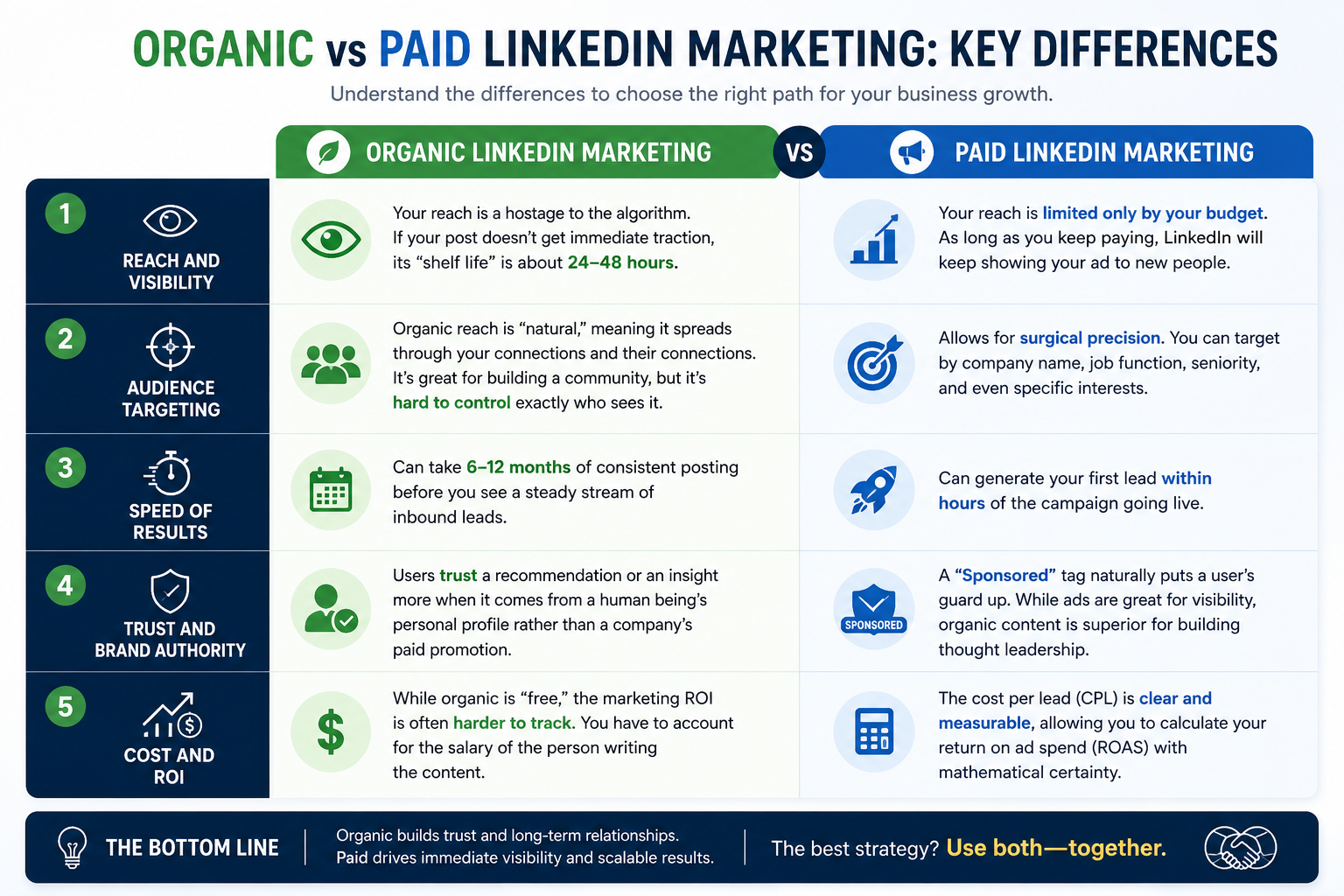
Organic vs Paid LinkedIn Marketing-Key Differences

Organic vs Paid LinkedIn Marketing: Key Differences

To choose the right path, you need to understand how these two strategies perform under pressure.

1. Reach and Visibility

In the organic world, your reach is a hostage to the algorithm. If your post doesn’t get immediate traction, its “shelf life” is about 24–48 hours. With paid marketing, your reach is limited only by your budget. As long as you keep paying, LinkedIn will keep showing your ad to new people.

2. Audience Targeting

Organic reach is “natural,” meaning it spreads through your connections and their connections. It’s great for building a community, but it’s hard to control exactly who sees it. Paid marketing, however, allows for surgical precision. You can target by company name, job function, seniority, and even specific interests.

3. Speed of Results

This is the biggest differentiator. Organic linkedin marketing can take 6–12 months of consistent posting before you see a steady stream of inbound leads. Paid advertising can generate your first lead within hours of the campaign going live.

4. Trust and Brand Authority

A “Sponsored” tag naturally puts a user’s guard up. While ads are great for visibility, organic content is superior for building thought leadership. Users trust a recommendation or an insight more when it comes from a human being’s personal profile rather than a company’s paid promotion.

5. Cost and ROI

While organic is “free,” the marketing ROI is often harder to track. You have to account for the salary of the person writing the content. With paid ads, the cost per lead (CPL) is clear and measurable, allowing you to calculate your return on ad spend (ROAS) with mathematical certainty.
FeatureOrganic MarketingPaid Marketing
Primary GoalTrust & AuthorityLeads & Scale
TargetingNetwork-basedData-based (Precision)
Results SpeedSlow / Long-termInstant / Immediate
CostTime / LaborDirect Ad Spend
LongevityHigh (Evergreen content)Low (Stops when budget ends)

Benefits of Organic LinkedIn Marketing for B2B Brands

Why do the world’s biggest B2B brands still spend hours on organic content? Because it builds an “Economic Moat.”

1. Sustainable Growth: Once you have a following of 50,000 targeted professionals, you have an asset that generates value for years without you having to pay for every click.

2. Higher Lead Quality: Leads coming through organic social selling are often “warm.” They already know your voice and trust your expertise, leading to a faster sales cycle.

3. Employee Advocacy: When your team shares content, it humanizes the brand. Personal profiles on LinkedIn see 561% more reach than company pages.

For a deeper dive into how the system prioritizes these organic interactions, check out our guide on the LinkedIn Algorithm Explained.

Benefits of Paid LinkedIn Marketing for B2B Brands

LinkedIn Ads are the “Gold Standard” for B2B for a reason.

1. Account-Based Marketing (ABM): You can upload a list of 500 specific companies you want to close and show ads only to the decision-makers at those firms.

2. Predictable Lead Flow: If you know that every $1,000 in spend generates 10 qualified leads, you can scale your business with confidence.

3. Retargeting: This is the “secret sauce.” You can show ads specifically to people who visited your website but didn’t convert, keeping your brand top-of-mind during their long B2B customer journey.

When Should Businesses Choose Organic LinkedIn Marketing?

Choose an organic-first strategy if:

1. You are in a trust-heavy industry: Consulting, legal, and high-end enterprise software require a lot of “educational” touchpoints before a sale.

2. You have a strong “Face of the Brand”: If your CEO or founder is a natural communicator, their personal brand will be your greatest organic asset.

3. You are playing the long game: You want to reduce your cost per lead over time by building a community that advocates for you.

When Should Businesses Choose Paid LinkedIn Marketing?

Lean into paid marketing if:

1. You have a tight deadline: You’re launching a new product, hosting a webinar next week, or need to hit a quarterly sales target.

2. Your niche is hyper-specific: If you only care about “Chief Information Security Officers at hospitals with 500+ beds,” the organic algorithm will never be precise enough to find them all.

3. You have the budget to test: Paid ads require an “experimentation phase.” If you can afford to spend $2,000–$5,000 to find your winning message, the scalability is unmatched.

Can Organic and Paid LinkedIn Marketing Work Together?

In 2026, the most successful brands don’t choose—they integrate. This is known as a full-funnel strategy.

The Synergy Workflow:

1. Test Organically: Post three different insights on your personal profile.

2. Boost the Winner: Take the post with the highest linkedin engagement and turn it into a Sponsored Content ad. Why? Because the audience has already “voted” that it’s a good post.

3. Retarget the Engaged: Create a custom audience of people who clicked your organic post and show them a Paid Lead Gen Form offering a deeper case study or a demo.

By combining both, you use organic content to build the “Who” (brand) and paid ads to drive the “What” (action).

Common Mistakes Businesses Make

Even with a big budget or a great writer, many B2B brands fail because:

1. Relying Only on Ads: If a prospect sees your ad, clicks your profile, and sees that you haven’t posted anything in six months, you lose all credibility.

2. Ignoring the Comments: Both in organic posts and ads, the comment section is where the real lead nurturing happens. Ignoring a question is like hanging up on a prospect.

3. Vanity Metric Obsession: Getting 1,000 likes on a meme is great for the ego, but if none of those people are in your target industry, the marketing roi is zero.

4. Weak CTAs: Telling people to “Learn More” is boring. Tell them to “Download the 2026 Benchmark Report” or “Get Your Free Technical Audit.”

Final Thoughts

There is no universal “winner” in the battle of organic vs paid linkedin marketing. If you want to build a brand that lasts a decade, you need organic. If you want to build a sales pipeline that hits its numbers next month, you need paid.

The most effective b2b marketing strategy is a “Hybrid Model”: Use organic content to create a presence that people trust, and use paid ads to ensure that the people who need to see that presence actually do.

Navigating the complexities of LinkedIn’s ever-changing platform can be a full-time job. Whether you need a data-driven ad campaign or a content strategy that actually converts, our team is here to help. Contact us at Digitally Bugged to start building your custom LinkedIn roadmap today. For more technical benchmarks on ad performance, the LinkedIn Marketing Solutions Blog is a great external resource to keep your strategy sharp.

FAQ Section

1. What is the difference between organic and paid LinkedIn marketing?

Organic marketing is unpaid content that relies on the algorithm and network engagement for reach. Paid marketing involves paying LinkedIn to show your content to a specific target audience via the ad auction.

2. Is organic LinkedIn marketing effective for B2B?

Yes, it is the best way to build thought leadership and trust. While it is slower than paid ads, organic content often results in higher-quality leads and lower long-term acquisition costs.

3. Are LinkedIn Ads worth it for B2B businesses?

Absolutely. LinkedIn Ads provide the most precise professional targeting in the world. For high-ticket B2B services (SaaS, consulting, etc.), the higher cost per lead is often justified by the high lifetime value of the customer.

4. Which strategy generates better LinkedIn leads?

It depends on your goal. Organic generates “warmer” leads who are already familiar with your brand. Paid generates “higher volume” leads and allows you to reach people who would never have discovered you naturally.

5. Can businesses combine organic and paid LinkedIn strategies?

Yes, this is the recommended approach. Successful brands use organic content to test ideas and build trust, then use paid ads to scale their best-performing content and retarget interested users.

6. How does LinkedIn organic reach work?

LinkedIn’s algorithm evaluates a post based on its initial engagement (likes, comments, shares) and “dwell time.” If the post provides value to a specific niche, the algorithm expands its distribution to people with similar interests.

We are the ingenious team that untangles the complex and turns it into something zesty!

Contact Us

Aston Building, 10th Floor,
Lokhandwala Complex,
Andheri West, Mumbai,
Maharashtra 400053

© 2025 – 2026 | Alrights reserved by Digitally Bugged

Email

Have a project in your mind?

09 : 00 AM - 05 : 00 PM

Monday – Friday

© 2022 – 2025 | Alrights reserved by Digitally Bugged

Email

Have a project in your mind?

09 : 00 AM - 05 : 30 PM

Monday – Friday

Shares