

Scroll through LinkedIn for five minutes and you will notice something quickly: a lot of people are posting, but not many are actually saying anything memorable.
That is the difference between being active and building LinkedIn thought leadership.
Thought leadership on LinkedIn is not about sounding overly polished, chasing viral hooks, or posting daily just to stay visible. It is about becoming known for useful ideas, clear opinions, and consistent expertise in a specific area. Over time, that is what makes people trust your voice, remember your name, and come back to your content.
Thought leadership on LinkedIn is not about sounding overly polished, chasing viral hooks, or posting daily just to stay visible. It is about becoming known for useful ideas, clear opinions, and consistent expertise in a specific area. Over time, that is what makes people trust your voice, remember your name, and come back to your content.
For founders, consultants, marketers, executives, and subject-matter experts, LinkedIn is one of the strongest platforms to build professional authority. It gives you a place to share insights, join industry conversations, and turn expertise into visibility. When done well, it can support brand credibility, inbound opportunities, partnerships, and even lead generation. As Digitally Bugged has also highlighted in its guide to LinkedIn content strategy for B2B and personal branding, the platform works best when content is aligned with a clear audience and business purpose
In this guide, we will break down what LinkedIn thought leadership really means, how to build it, what kind of content works, and how to make your posts feel insightful rather than generic.
What is LinkedIn thought leadership?
LinkedIn thought leadership is the practice of sharing original, useful, and relevant ideas that help people understand a topic better, see a problem differently, or make smarter decisions in their industry. It is not just about posting often. It is about being recognized for the quality of your thinking.
A thought leader usually does three things well. First, they have a clear area of expertise. Second, they communicate that expertise in a way that is simple and helpful. Third, they stay consistent long enough for people to associate their name with that topic.
This aligns with broader definitions of thought leadership from professional and research organizations, which describe it as influencing others through expertise, insight, and a distinct perspective rather than pure promotion.
On LinkedIn, that might look like:
- 1. a founder sharing lessons from scaling a business
- 2. a recruiter explaining hiring trends with real observations
- 3. a marketer breaking down what is changing in paid media
- 4. a consultant calling out common mistakes clients keep making
- 5. an executive offering a clear perspective on an industry shift
The important part is this: thought leadership on LinkedIn is not built by sounding smart. It is built by being useful.
Why LinkedIn is the right place for thought leadership
Not every platform rewards expertise in the same way. LinkedIn does.
People come to LinkedIn with a professional mindset. They are more open to industry conversations, practical advice, case-based learning, and expert commentary than they are on most social platforms. That makes it a strong environment for professionals who want to build authority around what they know.
LinkedIn also has a natural trust advantage. Profiles show work history, role, industry context, and network signals. So when someone shares a well-argued insight, readers can instantly connect that insight to real-world experience. That context makes expert content feel more credible.
This is one reason LinkedIn is often central to B2B visibility and trust-building strategies. Digitally Bugged’s article on LinkedIn SEO and profile optimization also points out that a strong profile helps people discover and trust you before you ever start a conversation.
In simple terms, LinkedIn gives thought leaders three things at once:
- 1. discoverability
- 2. professional context
- 3. audience intent
That combination is powerful.
Who should build thought leadership on LinkedIn?
A lot of people assume thought leadership is only for CEOs or creators with huge audiences. It is not.
You should consider building thought leadership on LinkedIn if you are:
- 1. a founder trying to become more visible in your niche
- 2. a consultant who wants to attract better-fit clients
- 3. a marketer who wants to be known for strategic thinking
- 4. an executive representing a company point of view
- 5. a freelancer building authority in a crowded market
- 6. a subject-matter expert with practical experience others can learn from
- 7. a B2B professional who wants to create trust before outreach begins
What a strong LinkedIn thought leadership strategy looks like
A good LinkedIn thought leadership strategy is not random posting with better wording. It has structure behind it.
Here are the core elements.
1. A clear niche
If you talk about everything, people remember nothing.
The strongest thought leaders usually stay close to a few themes. For example, one person may focus on B2B growth marketing, another on hiring and culture, and another on SaaS product positioning. A clear niche helps readers know what to expect from you.
2. A recognizable point of view
Thought leadership is not repeating what everyone already agrees with. It is adding interpretation.
You do not need to be controversial for the sake of it, but you do need a perspective. What do you believe most people in your industry misunderstand? What patterns do you keep seeing? What advice sounds good in theory but fails in practice?
That is where memorable content comes from.
3. Content pillars
Instead of asking “What should I post today?” every morning, build 3 to 5 content pillars.
For example:
- 1. industry trends
- 2. client lessons
- 3. mistakes to avoid
- 4. frameworks and systems
- 5. behind-the-scenes learnings
This keeps your content consistent without making it repetitive.
4. Profile credibility
Your profile should support your content. If your posts speak like an expert but your profile is vague, the trust breaks.
Your headline, About section, featured links, and experience should clearly show your area of expertise and the kind of value you bring.
5. Real engagement
Thought leadership on LinkedIn is not built through broadcasting alone. It grows faster when you participate in conversations, add value in comments, and respond thoughtfully to people in your niche.
How to become a thought leader on LinkedIn
If you are wondering how to become a thought leader on LinkedIn, the process is more practical than people think.
Step 1: Decide what you want to be known for
Start with one question: what should someone remember you for after seeing five of your posts?
That answer should not be too broad. “Marketing” is too broad. “LinkedIn strategy for B2B brands” is much clearer. “SEO for early-stage service businesses” is clearer. “Hiring systems for fast-growing teams” is clearer.
Specificity makes authority easier to build.
Step 2: Understand who you are speaking to
Thought leadership content works better when it feels written for someone, not for everyone.
Ask:
- 1. Who is the ideal reader?
- 2. What are they struggling with?
- 3. What questions do they keep asking?
- 4. What bad advice are they surrounded by?
The best thought leadership content on LinkedIn usually solves confusion, not just a lack of information.
Step 3: Build 3 to 5 themes you can speak on repeatedly
This is where most people make LinkedIn easier for themselves.
Choose a few themes and return to them consistently. For example, if you are in digital marketing, your themes might be:
- 1. LinkedIn strategy
- 2. B2B content
- 3. lead generation
- 4. campaign analysis
- 5. brand positioning
Now you are no longer inventing content from scratch every time. You are developing depth around a known set of topics.
Step 4: Share original insights, not just summaries
One of the fastest ways to blend in is to repost widely known tips with slightly different wording.
Instead, try sharing:
- 1. what changed your mind about something
- 2. what clients consistently get wrong
- 3. what has worked in your experience
- 4. what trend is being misread
- 5. what framework helps simplify a common challenge
This is the heart of building thought leadership on LinkedIn. People follow original thinking, not recycled phrasing.
Step 5: Write in a way people can actually read
Many professionals weaken their message by trying to sound too formal.
Strong LinkedIn thought leadership posts usually feel:
- 1. clear
- 2. direct
- 3. structured
- 4. grounded in experience
- 5. easy to skim
That means short paragraphs, simple language, and a strong opening. You are not writing for a boardroom memo. You are writing for a scrolling human being.
Step 6: Be consistent enough to become recognizable
One good post can get attention. Repeated good posts build authority.
You do not need to publish every day. But you do need enough consistency for readers to connect your name with your topic. That is how trust compounds.
The Association for Talent Development also notes that consistency around a few chosen topics helps professionals establish expertise over time on LinkedIn.
What are thought leadership posts on LinkedIn?
A lot of people ask this because the phrase sounds bigger than it needs to be.
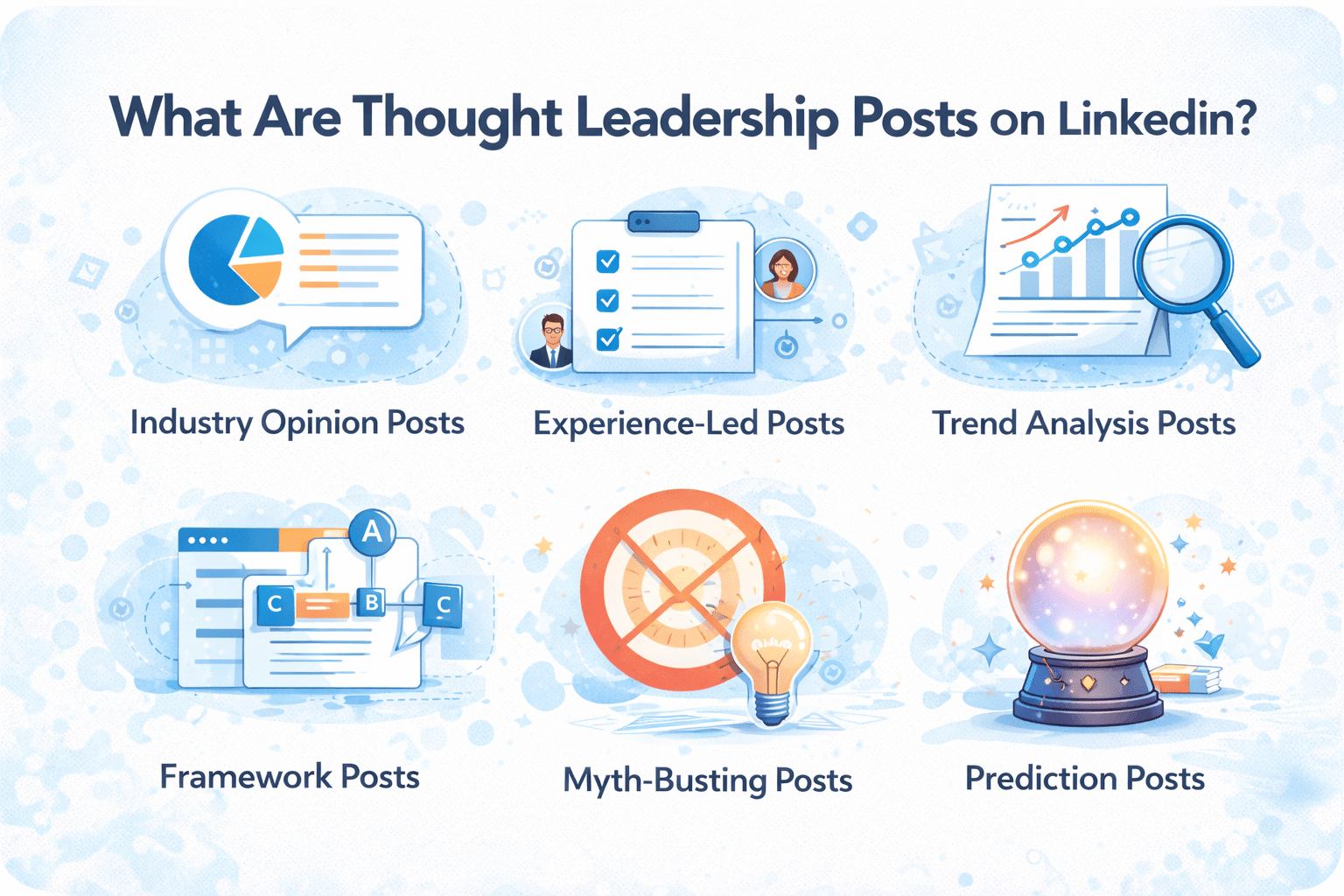
Thought leadership posts on LinkedIn are posts that offer insight, perspective, or interpretation based on expertise. They do not just announce something. They teach, clarify, challenge, or frame something in a better way.
Here are a few examples of what that can include:
1. Industry opinion posts
These share a clear take on what is changing, overhyped, underused, or misunderstood.
2. Experience-led posts
These come from real work. A lesson from a campaign, a client pattern, a hiring challenge, or a product decision.
3. Framework posts
These simplify a problem into steps, models, or repeatable systems.
4. Trend analysis posts
These explain what a trend means in practice, not just that it exists.
5. Myth-busting posts
These challenge weak assumptions or popular bad advice.
6. Prediction posts
These offer informed expectations about where a topic is heading and why.
The biggest difference between generic content and strong LinkedIn thought leadership posts is that the latter add interpretation. They help the audience think better.
LinkedIn thought leadership examples
Let’s make this more practical.
Here are a few LinkedIn thought leadership examples that feel strong because they are specific and experience-driven.
Example 1: Founder perspective
A founder writes:
“Early-stage companies often think they need more leads. In reality, they need better sales feedback loops. We improved conversions only after marketing and sales reviewed lost deals together each week.”
Why this works: it is specific, rooted in experience, and offers a useful shift in perspective.
Example 2: Marketing perspective
A marketer writes:
“Most B2B LinkedIn content fails because it tries to sound smart before it tries to be clear. Clarity gets saved. Cleverness gets ignored.”
Why this works: it is opinionated, easy to understand, and relevant to a common problem.
Example 3: Hiring perspective
An HR leader writes:
“We stopped screening candidates for polish and started screening for learning speed. Our strongest hires were not always the most interview-ready.”
Why this works: it challenges a familiar process and offers an informed viewpoint.
Example 4: Consultant perspective
A consultant writes:
“The reason many service firms struggle with inbound content is simple: they post advice their peers admire, not advice buyers actually need.”
Why this works: it separates audience validation from market relevance.
These examples show something important. Thought leadership is not about sounding inspirational. It is about saying something true, useful, and earned.
Common mistakes that weaken thought leadership on LinkedIn
Even smart professionals lose momentum when their content falls into predictable traps.
1. Being too generic
If your content could have been written by anyone in any niche, it will not build authority.
2. Posting motivational fluff instead of insight
There is nothing wrong with encouragement, but encouragement alone does not create expertise.
3. Talking only about yourself
Readers care about your experience only when it helps them learn something.
4. Sounding overly corporate
Stiff writing creates distance. Human writing creates connection.
5. Chasing trends without relevance
Not every trending format fits your audience or expertise.
6. Inconsistency
If you disappear for long stretches, it becomes harder for people to associate your name with a topic.
Best practices for building thought leadership on LinkedIn
If you want a practical checklist, focus on these habits.
1. Stay close to a niche.
Return to the same themes often enough that people know what you stand for.
2. Add a point of view.
Do not stop at information. Explain what it means and why it matters.
3. Write from experience.
Examples, observations, and lessons make content feel more credible.
4. Optimize for clarity.
A useful post written simply will outperform a vague post written elegantly.
5. Engage with others.
Thought leadership grows faster when you contribute to the broader conversation.
6. Review what gets quality response.
Not just likes. Look for comments, saves, profile visits, and inbound conversations. As Digitally Bugged notes in its LinkedIn analytics guide, these signals help refine what content actually supports reach, engagement, and lead generation.
Does LinkedIn thought leadership help generate business opportunities?
Yes, but not in the instant, transactional way many people expect.
Thought leadership usually works earlier in the trust cycle. It helps people become familiar with your perspective before they ever book a call, reply to outreach, or consider your service. That matters a lot in B2B, where decisions are slower and credibility plays a major role.
Someone may not buy because of one post. But they may start noticing your name because of several useful posts. Then they visit your profile. Then they read more. Then they trust that you understand the problem they are facing.
That is where thought leadership becomes commercially valuable. It warms up attention before conversion.
Final thoughts
Building LinkedIn thought leadership does not require a massive audience, fancy language, or nonstop posting. It requires clarity, consistency, and a willingness to say something useful from real experience.
The people who stand out on LinkedIn are not always the loudest. They are often the clearest. They know what they want to be known for, they speak to a specific audience, and they keep showing up with ideas that help people think better.
That is the real goal.
If your content can make your audience pause and say, “That is exactly what I was trying to understand,” you are already moving in the right direction.
Frequently Asked Questions
1. What is thought leadership on LinkedIn?
It is the practice of building authority by sharing useful, original, and relevant insights on LinkedIn around a specific area of expertise.
2. What are thought leadership posts on LinkedIn?
These are posts that teach, interpret, challenge, or clarify a topic through experience, perspective, or informed analysis.
3. How do you become a thought leader on LinkedIn?
Choose a clear niche, optimize your profile, build content themes, share original insights consistently, and engage with the right audience over time.
4. What is the difference between personal branding and thought leadership?
Personal branding is how you present and position yourself. Thought leadership is how you demonstrate expertise and influence through ideas. They often work together, but they are not the same thing.